
Your cart
Sub-Total: $0.00
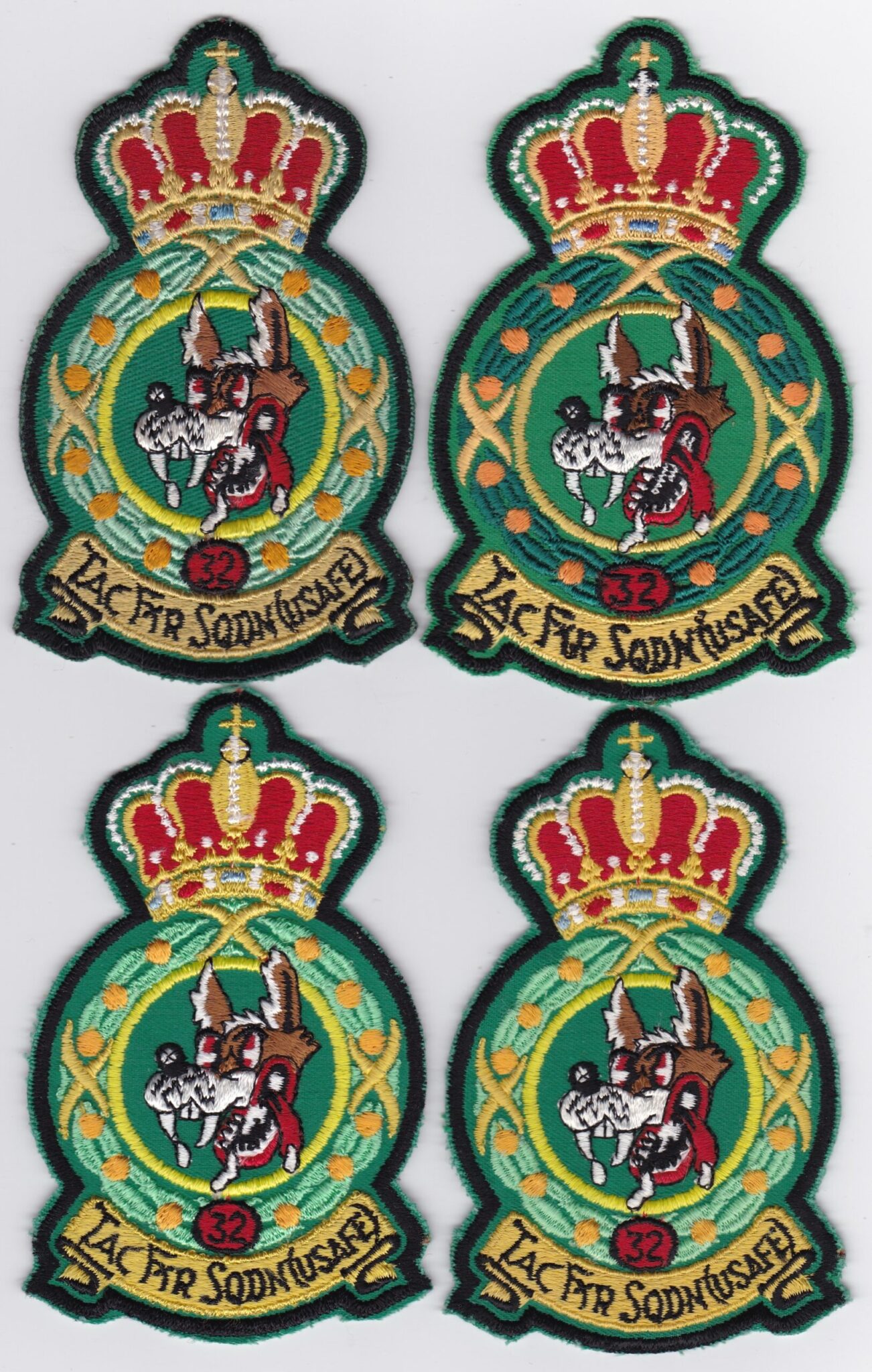
The 32d Tactical Fighter Squadron “Wolfhounds” is one of the most distinctive USAFE units, with a history spanning the Second World War, Cold War air defence of Europe, and later air operations command roles. Known for its unique Dutch Royal crest and Walt Disney-designed wolf emblem, the squadron became closely associated with Camp New Amsterdam at Soesterberg Air Base in the Netherlands.
View our collection of 32d TFS patches
The 32nd Fighter Squadron was activated during the Second World War as part of the United States Army Air Forces. Flying combat missions in the European Theatre, the squadron provided bomber escort, fighter sweeps and ground attack operations in support of Allied forces. During the war the squadron adopted the Wolfhound emblem, designed by Walt Disney Studios, symbolising its aggressive pursuit of enemy aircraft and German U-boat "wolf packs."
In 1955 the squadron was reactivated in Europe and assigned to Camp New Amsterdam, Soesterberg Air Base, becoming the only permanently based USAF flying squadron in the Netherlands. Initially equipped with the F-86F Sabre, it provided NATO air defence while assigned to the 36th Fighter Wing at Bitburg Air Base, West Germany.
The squadron converted to the F-102 Delta Dagger in 1960, becoming one of USAFE's principal interceptor units. Protecting NATO airspace throughout the Cold War, the Wolfhounds achieved an exceptional operational record and won the Hughes Trophy three times as the USAF's outstanding fighter interceptor squadron.
Following another redesignation as the 32nd Tactical Fighter Squadron, the unit received the F-4D Phantom II in 1969. The Phantom introduced a multirole capability, allowing the squadron to undertake both air defence and tactical fighter missions while continuing NATO commitments from Soesterberg.
The arrival of the F-15A Eagle in 1978 transformed the squadron into one of NATO's premier air superiority units. Operating from Camp New Amsterdam, the Wolfhounds maintained continuous Quick Reaction Alert commitments while participating in numerous multinational exercises throughout Europe.
During Operations Desert Shield and Desert Storm, the squadron deployed to Incirlik Air Base, Turkey, from August 1990 to March 1991. On 28 January 1991, a 32nd Fighter Squadron F-15 Eagle was credited with destroying an Iraqi MiG-23, demonstrating the Eagle's combat effectiveness.
The squadron remained deployed in support of Operation Provide Comfort before being redesignated the 32nd Fighter Squadron on 1 November 1991.
In 1989 the USAF expanded its presence by activating the 32nd Tactical Fighter Group at Soesterberg. Following the end of the Cold War, however, force reductions led to the closure of Camp New Amsterdam. The flying squadron left the Netherlands in 1994, ending nearly four decades of continuous USAF fighter operations at Soesterberg.
The 32nd designation continued within USAFE as the 32nd Air Operations Group and later the 32nd Air Operations Squadron, supporting NATO air operations from Ramstein Air Base until its inactivation in 2005
The 32d Fighter Squadron insignia is one of the most distinctive in USAFE history. The original Wolfhounds emblem, designed by Walt Disney Studios during the Second World War, features a stylised wolf’s head representing the squadron’s anti-submarine patrol role.
In 1959, the squadron was authorised to incorporate elements of the Dutch Royal Air Force crest, including the Royal crown and orange wreath, reflecting its role in defending the Netherlands during the Cold War. This combination of American and Dutch symbolism makes the 32d TFS patches highly distinctive and collectible.
| Year | Aircraft | Location | Key Events |
|---|---|---|---|
| 1942 | P-39 Airacobra | United States | Activated as the 32nd Fighter Squadron during the Second World War as part of the 36th Fighter Group. |
| 1943–1945 | P-47 Thunderbolt | North Africa, Italy, France & Germany | Flew bomber escort, fighter sweep, close air support and ground attack missions in the Mediterranean and European Theatres. |
| 1945 | P-47 Thunderbolt | Germany | Remained in Europe as part of the occupation forces following Victory in Europe. |
| 1946 | — | Germany | Squadron inactivated following post-war reductions. |
| 1952 | F-86F Sabre | Bitburg AB, West Germany | Reactivated with the 36th Fighter Wing as NATO expanded its Cold War air defences. |
| 1955 | F-86F Sabre | Camp New Amsterdam, Soesterberg AB, Netherlands | Replaced the 512th Fighter-Day Squadron and became the only permanently based USAF flying squadron in the Netherlands. |
| 1958 | F-86F Sabre | Soesterberg | Redesignated the 32nd Tactical Fighter Squadron. |
| 1959 | F-86F Sabre | Soesterberg | Awarded the Dutch Royal Crown and Orange Wreath, recognising its contribution to the defence of the Netherlands. |
| 1959 | F-86F Sabre | Soesterberg | Redesignated the 32nd Fighter Interceptor Squadron as NATO's air defence mission expanded. |
| 1960 | F-102A Delta Dagger | Soesterberg | Converted to the F-102A Delta Dagger interceptor. |
| 1960s | F-102A Delta Dagger | Soesterberg | Won the prestigious Hughes Trophy three times as the USAF's outstanding interceptor squadron. |
| 1968 | F-102A Delta Dagger | Soesterberg | Administrative control transferred to Seventeenth Air Force, Sembach AB, West Germany. |
| 1969 | F-4D Phantom II | Soesterberg | Redesignated the 32nd Tactical Fighter Squadron and converted to the F-4 Phantom II. |
| 1978 | F-15A/B Eagle | Soesterberg | Became one of the first USAFE squadrons to receive the new F-15 Eagle. |
| 1980s | F-15 Eagle | Soesterberg | Maintained NATO Quick Reaction Alert and participated in numerous multinational exercises. |
| 1989 | F-15 Eagle | Soesterberg | 32nd Tactical Fighter Group activated, expanding the USAF presence in the Netherlands. |
| 1990–1991 | F-15 Eagle | Incirlik AB, Turkey | Deployed for Operations Desert Shield and Desert Storm. |
| 28 January 1991 | F-15 Eagle | Iraq | Credited with destroying an Iraqi MiG-23 during combat operations. |
| 1991–1993 | F-15 Eagle | Turkey | Continued deployments supporting Operation Provide Comfort. |
| 1 November 1991 | F-15 Eagle | Soesterberg | Redesignated the 32nd Fighter Squadron following USAF restructuring. |
| 1994 | — | Ramstein AB, Germany | Flying squadron inactivated. Personnel transferred to the 32nd Air Operations Squadron as Camp New Amsterdam closed. |
| 1994–2005 | Air Operations | Ramstein AB | The 32nd designation continued through the 32nd Air Operations Group and later the 32nd Air Operations Squadron, supporting USAFE command and control. |
| 2005 | — | Ramstein AB | 32nd Air Operations Squadron inactivated, bringing the lineage to a close. |