
Your cart
Sub-Total: $0.00
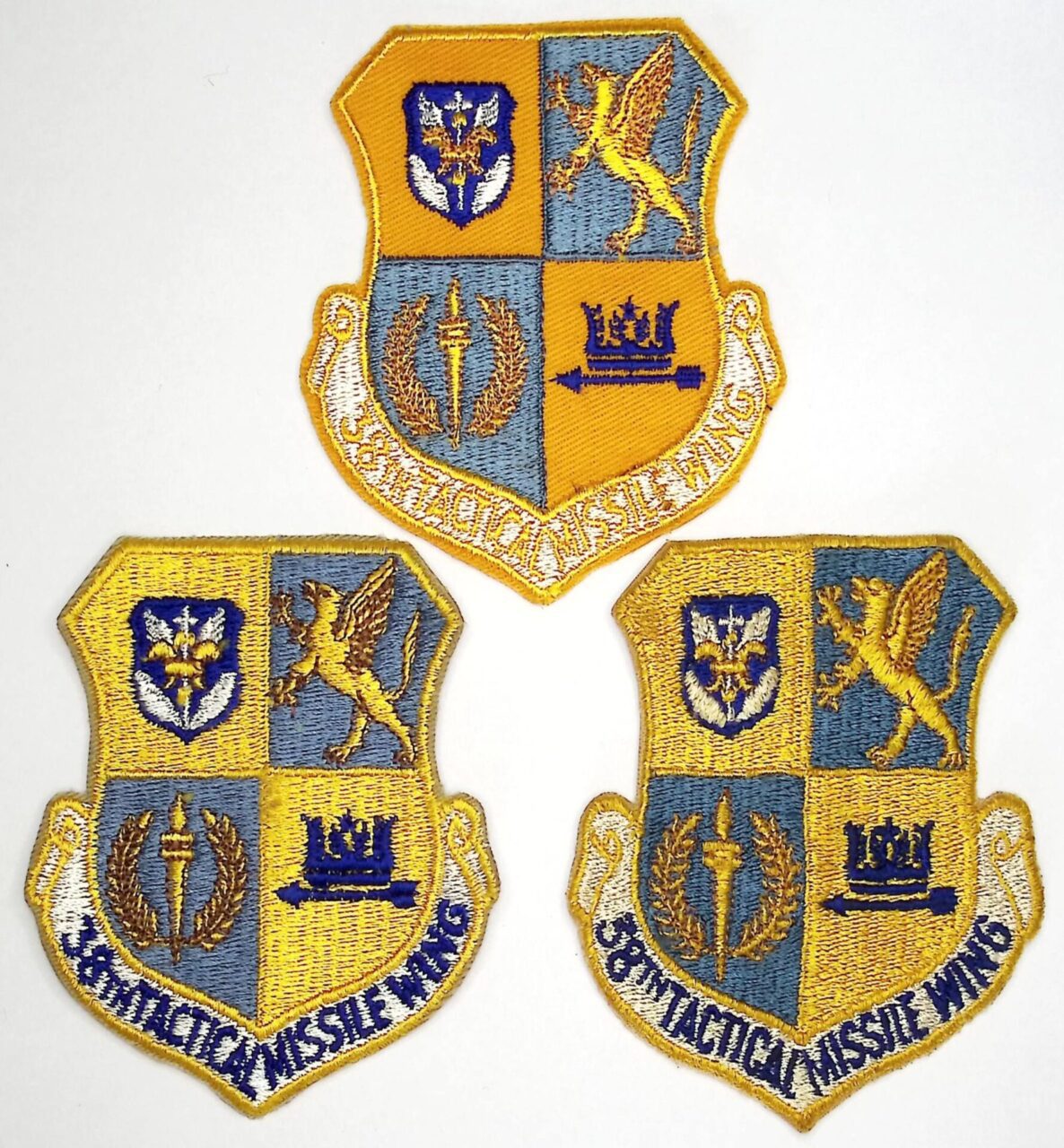
The USAF 38th Wing lineage includes the 38th Bombardment Wing, 38th Tactical Missile Wing, 38th Flying Training Wing, 38th Engineering Installation Wing and 38th Combat Support Wing, serving in roles ranging from strategic bombing and pilot training to Cold War nuclear missile operations and global communications support. From B-26 Invader operations in post-war Japan to BGM-109G Gryphon Ground Launched Cruise Missile deployments in West Germany, the 38th Wing played an important role in United States Air Force and NATO operations during the Cold War era.
Review the Tactical Missile Wing Patches including 38th
See 38th Tactical Missile Wing BG-109G Gryphon GLCM patch from the Cold War
The United States Air Force activated the 38th Bombardment Wing (Light) at Itami Airfield on 10 August 1948 as part of the newly introduced Hobson Plan wing organisation system.
The wing was assigned the 38th Bombardment Group, equipped with Douglas B-26 Invader light bomber and ground attack aircraft. The unit’s primary mission was the defence of Japan during the early Cold War period following the Second World War.
The 38th Bombardment Wing conducted training exercises and operational readiness missions throughout Japan before being inactivated on 1 April 1949 due to post-war United States defence budget reductions.
The 38th Tactical Missile Wing (38th TMW) was activated on 18 June 1958 following the redesignation of the 701st Tactical Missile Wing at Hahn Air Base under the command of the 17th Air Force.
The wing operated and maintained TM-67A Matador cruise missiles before transitioning to the more advanced TM-76A Mace tactical cruise missile system during the early 1960s.
The 38th Tactical Missile Wing controlled multiple missile launch facilities across West Germany, supporting NATO nuclear deterrence operations during the Cold War.
On 20 August 1959, headquarters for the 38th Tactical Missile Wing moved to Sembach Air Base. The wing remained operational until its inactivation on 25 September 1966.
The wing was reactivated as the 38th Flying Training Wing on 1 August 1972 at Laredo Air Force Base, replacing the 3640th Pilot Training Wing as part of the removal of MAJCOM-controlled units.
The wing supervised the 70th and 71st Flying Training Squadrons, both equipped with Northrop T-38 Talon advanced jet trainer aircraft. The unit provided advanced undergraduate pilot training for future USAF pilots during the Vietnam War and Cold War era.
The 38th Flying Training Wing was inactivated on 1 December 1975 following the closure of Laredo Air Force Base.
The 38th Tactical Missile Wing was reactivated in April 1985 at Wüschheim Air Station to operate the BGM-109G Ground Launched Cruise Missile (GLCM) system.
The deployment formed part of NATO’s response to the Soviet Union’s SS-20 intermediate-range missile programme introduced during the 1970s.
Operating under Seventeenth Air Force, the wing controlled the 89th Tactical Missile Squadron and maintained 80 BGM-109G Gryphon cruise missiles. The missiles were organised into five operational flights, each equipped with:
The 38th Tactical Missile Maintenance Squadron provided technical and operational support for the missile force.
During periods of increased Cold War tension, missile flights deployed from Wüschheim Air Station to pre-surveyed concealed locations throughout the West German countryside.
Launch teams established defensive positions, erected camouflage systems, deployed intrusion detection radar and prepared the missiles for potential launch operations while maintaining operational secrecy and survivability.
The Reykjavík Summit in Iceland on 11 October 1986 between US President Ronald Reagan and Soviet General Secretary Mikhail Gorbachev led to an agreement in principle to remove Intermediate-Range Nuclear Forces from Europe.
The Intermediate-Range Nuclear Forces Treaty was signed on 8 December 1987 and came into force on 1 June 1988. The treaty resulted in the complete removal of all intermediate-range nuclear missiles from Western Europe.
Following the withdrawal and decommissioning of the BGM-109G Gryphon missile system in Germany, the 38th Tactical Missile Wing was officially inactivated on 22 August 1990.
The 38th Engineering Installation Wing was activated on 8 November 1994 at Tinker Air Force Base under the USAF Electronic Systems Center.
The wing assumed responsibility for the personnel and equipment previously operated by the USAF Communications Systems Center. Its mission focused on the centralised management of worldwide USAF electronics engineering, communications infrastructure and installation resources.
The wing supported the development and installation of advanced communications and electronic systems across the global USAF network.
The 38th Engineering Installation Wing was inactivated on 3 February 2000, with its responsibilities transferred to the subordinate 38th Engineering Installation Group.
The 38th Combat Support Wing was activated on 25 May 2004 at Ramstein Air Base to coordinate support operations for more than 70 geographically separated United States Air Forces in Europe units across Europe.
The wing was responsible for improving operational support, logistics coordination and administrative services for USAFE facilities located throughout the European theatre.
Following a USAFE review, it was determined that support operations could be managed more effectively at local base level without an additional layer of command bureaucracy. As a result, the 38th Combat Support Wing was officially inactivated on 30 September 2007.